

A Few Things First
I didn’t realize how much time has passed since I last posted, so I apologize for the delay in getting this article out on calculating the house cusps. I’ve had some internet issues the last few weeks, so that’s been part of it. Another part has been a shift that spontaneously began happening that is allowing me to approach my work in a way that is more sustainable for me. The shift has resulted in me giving space to the creative impulses that arise as I’m working on something else. I am learning that attending to these keeps me engaged and excited and looking forward, which is good for my overall energy levels. It also means my articles don’t get written as quickly.
Emerging Business Plan
Another positive that happened during these couple of weeks is that a business model has begun to shape itself. My vision for this Substack has always been to keep it free for anyone interested, with an option to subscribe at a paid level for those who would like to. That continues to be my vision, although, as often happens when I state something, an idea is spawning about a paid tier offering that is outside of sharing knowledge and personal insights, etc (see the video idea at the end of this section).
But, regarding the business model, the piece that has begun to shape itself arose after I put the digital phase cards I made up for sale. I had never done anything like that before and it was revelatory. I really like that process of creating something and then offering it for sale. Love having my own store. It made me feel whole for the first time in my life, like I finally knew who I was. (I have a Gemini Midheaven.)
With the free model in mind, my plan is to continue writing here, with a focus on writing article series exploring astrology concepts and practical applications, and then reshaping those into more formal courses and other products that come out of the process. Substack is wonderful in so many ways, but, based on my experience writing the chart calculation series articles. it’s not the best for presenting structured course material. My plan, though, is to keep writing those articles and keep them freely available here, but charge for the courses and products that I create from them. I will more than likely host those on another platform.
This model fits with a long-term goal of mine, which is to create an astrology-focused learning platform. Right now, one thing I can do on that front is slowly build a more solid knowledge base. Substack is a place where I can share what I learn as I go with those interested who read and subscribe and pass by. The courses will take things one step further.
As I was writing this update, another idea presented itself. It is an idea that is still in the inner stirring stage, so I’m not sure it will manifest. But I want to talk about it because, with it, an idea for a paid tier is also presenting itself (see next paragraph). The stirring has to do with making videos where I talk about current events from an astrological perspective. In terms of time and energy, it might not be feasible until my health improves. But this inner stirring to talk about these times has been growing, and I think it could help to look at things through an astrological lens. Previously, my thinking was that it is better to focus on inner work. I think inner work is still essential and key. But, it may also be true that our growth comes from grappling with the worldly realm, too. Perhaps, looking at it directly can help, if done thoughtfully and humanly.
I’m not sure if Substack would be a primary platform for these videos or somewhere else. And I’m also not sure if these would be part of my freely-available offerings. Perhaps all of the learning articles and any more personal insight articles could be free and current events videos could be offered as part of a paid offering. That idea is appealing to me. Energetically, it feels inviting. But I’m not sure what will manifest.
Please feel free to share your thoughts and comments on any of these shifts, shapings, and ideas.
Shifting Away from the Affiliate Model
If you have been reading past the end of the last few articles, you will have noticed that I was trying out an affiliate model. I have experimented with this model off and on over the years, resonating with what seems to be a win-win-win for all concerned, yet my energy and enthusiasm for the recommendations I make always dampen once I step into it. As Mercury turned direct, I finally realized in a resolving kind of way that it’s just not going to work for me. I don’t want to feel restricted in what I recommend to others. And I want what I offer to be the things I create and/or offer.
Thus, I have ended all affiliate partnerships, letting the relevant parties know I still love their products and services but that the affiliate business model isn’t right for me. So, receiving commissions for recommendations is no longer part of my business plan. In some cases, though, like with Notion, I will be creating products that I make available either for free or for sale. In fact, I have been working on a couple of ideas for things in Notion.
So that’s what I know so far :). It feels good to have some sense of direction after a lifetime of flailing and spinning. Thank you to everyone who has supported me here and those who have supported me as I have been healing and finding my way.
About this Article
The article below is the next one in the chart calculation series. It goes through the process for calculating house cusps, which is the last step we need to be able to calculate a chart for a specific location. It is not the last article in the series, though. We will still need to go over what to do when a chart is set for the Southern Hemisphere.
Thus, in the next article, we’ll look at the Virgo New Moon, but set for somewhere south of the equator and probably somewhere east of the Prime Meridian. I hope to be able to cover the steps in one article, but it is possible it will take more than that. Once done, we will have covered all contingencies and you should be able to draw up a chart for an event anywhere in the world.
About the Timing of this Series
One final thing. I am sorry about the timing of this series in that it has continued past the Virgo New Moon. When I started it, while I thought it would be great if it was completed before the event happened, it wasn’t a primary goal. I should have stated that. My main goal was to pass on how to calculate charts by hand. My reasons for choosing the Virgo New Moon were because: 1) it was a lunation, thus did not pose any ethical or privacy issues; 2) it was an event for this year, which meant I could use a time zone resource that allowed me to use the data; 3) the event data was provided by a US government site, meaning it was freely available to use; and 4) the event time made it possible to show an example of the date changing when the time was converted to GMT, which I felt would be helpful to see.
I hope this series of articles has been helpful and thank you for sticking with them.
Introduction
In the last article, we went over how to calculate the planet positions. Knowing these, we were able to draw up a general chart for the Virgo New Moon on the natural wheel. The next step is to localize the chart to our event time and location. To do that, we need to determine the house cusps.
For those who don’t know astrology very well, the best way to think of the houses is in context with the planets and signs. We can think of these three things - planets, signs, and houses - as the primary layers of symbolism in astrology. The planets represent the dynamic energy of the chart and the signs represent the particular prisms filtering and bending the energies, while the houses represent the arenas in which the energies play out. In addition to these three layers, there are aspects that represent the dynamic relationships between the planets. Because the planets are located in signs and houses, we can think of the aspects as interconnecting all the layers.
House Basics
Sign-House Alignment
For every chart, the arenas, or houses, of which there are twelve, always occupy the same positions. And the signs, of which there are also twelve, always unfold around the chart in the same order. But, the alignment of signs and houses will vary depending on the event time and location. We calculate the houses so that we can determine what this alignment is for a given event.
On the natural wheel, which is not set for any specific location, Aries, the first sign in the zodiac, always aligns with the first house and each subsequent sign follows in turn, lining up with its corresponding house. Taurus, the 2nd sign, lines up with the second house, and Gemini, the 3rd sign, lines up with the third house, and so on. Thus, on the natural wheel, there is a natural correspondence between the order of the houses from one to twelve and the order of the signs from Aries to Pisces.
For a given event set for a specific time and location, though, the first house cusp, which remains fixed in terms of its location on the wheel, may align with a sign other than Aries, with the rest of the cusps falling in subsequent signs around the wheel. The reason the sign might differ is because, throughout the day, the signs rotate clockwise around the wheel.
Thus, if the time is right for a given event, a chart could have the first house cusp falling in Leo, which is the fifth sign in the natural order of the zodiac. In this case, from there, the second house cusp would fall in Virgo and the third house cusp would fall in Libra.1 Other house-sign alignments are possible depending on the time and location of the event.
Because the alignment depends on the location of the event in addition to the time, multiple charts for the same event, such as the Virgo New Moon, but set for different locations, will have different alignments of houses and signs. This difference in house-sign alignment won’t change what signs the planets are in nor the aspects between the planets. But the arenas in which the planets-in-signs and aspect dynamics play out will be different depending on this alignment.
Thus, the house cusps we find for the Virgo New Moon chart set for Los Angeles will be specific to Los Angeles, not Miami or Seoul or Jakarta, etc. When set for these, or other, locations, the house-sign alignments will be different.
The Matter of House Systems
Making sense of how houses are determined is, in my view, one of the most difficult parts of astrology, one that I have not begun to master. The calculations are based on spatially complex and abstract astronomical observations. Over the centuries and millennia, different people have come up with different conceptual and mathematical approaches for calculating the house cusps. These different approaches are known as house systems. Astro.com provides a comprehensive list of them, together with tables of houses for most.
All house systems, however, based on a spot-check I did of the tables of houses provided by astro.com, share the same angles. In other words, the degrees for the Midheaven and Ascendant listed for each of the house systems in their tables are the same for each time and latitude across house systems. Thus, the Ascendant and Midheaven, together with their opposites, the Descendant and IC, can be thought of as forming the anchors of the chart, with the different house systems divvying up the wheel space differently in terms of houses.
In some systems, the angles mark the start of houses, with the Ascendant marking the start of the first house, the Midheaven marking the start of the tenth house, the Descendant marking the start of the seventh house, and the IC marking the start of the fourth house. The difference in these house systems, thus, is not where the angular houses start, but how the quadrant spaces between the angles are divided up.
In the Whole Sign and Equal House systems, houses are determined differently. Either the Midheaven or the Ascendant is used to mark the positions of the house cusps, but the Midheaven and/or Ascendant may or may not mark the start of a house. For Whole Signs, neither does. For Equal Houses, one or the other does. How this works will make more sense near the end of the article when I talk more about these house systems in conjunction with the charts for the Virgo New Moon.
Which House System to Use
Which house system a person uses comes down to a matter of preference. Often, a person’s preference is based on precedent and/or the experience that one house system works better for them than others. Or it could simply be a matter of what’s available. Ideally, the system one uses also comes out of a study of the house systems - how they are determined and a sense of the symbolic significance of each that comes from that understanding.
I, personally, have not reached that ideal, though hope to. I started out using the Koch system because my first teacher used it. I then switched to the Porphyry house system because it is the preferred house system for the form of evolutionary astrology I studied. Currently, because of the design logistics of the phase charts I created to analyze charts, I use either Whole Sign houses or Whole Signs combined with Equal Houses.2
In terms of calculating house cusps, the Whole Sign and Equal House systems are the easiest in that all you have to do is find the cusp for either the Ascendant (first house cusp) or Midheaven (tenth house cusp) to determine the rest of the house cusps, though you still need to find the degree of the other angle so you can include the rest of the angles in the chart. Once again, this will make more sense towards the end of the article when I show the charts for the Virgo New Moon drawn up using these two house systems.
Calculation Process Overview
There are two different calculation processes we need to know to calculate charts. One, the shorter and less complex one, is for the Midheaven. The other, longer and more complex, though basically following the same steps in a sort of nested way, is for the Ascendant and the rest of the house cusps. In both, we will be mathematically comparing the data listed in the tables of houses (explained in the next section) to our event data, using that comparison to tweak the generic positions listed in the tables to our event time.
In the case of the calculations for the Midheaven, we only need to make this comparison as it relates to time. In the case of the Ascendant and other house cusps, we need to make it for the latitude, too. In the approach I will be showing for the Ascendant and other house cusps, we’ll tweak the position of the Ascendant latitude-wise before we tweak it time-wise.3
To keep things from getting more overwhelming than they need to, in this article, we will walk through the calculation processes for the Midheaven and the Ascendant. That will give us what we need to draw up the Virgo New Moon on an Equal Sign or Whole Sign chart. Knowing how to calculate the Ascendant, we can then take that knowledge and use it to calculate the rest of the house cusps. Rather than walking through the calculations for each one, in this article, I will just provide my results at the end of the article so you can compare your results. But if you would like to see the results of my calculation steps for the rest of the houses, see the Notion worksheets I have made public.*
More important than comparing your results to mine is to compare them with the results generated using a good quality astrology software program. For a free resource, I recommend astro.com but there are plenty out there.
Please feel free to ask questions if any come up while you are working through the steps. As always, I will do my best to answer.
*Note: I will have the calculation worksheets for the house cusps completed by the end of the week, with a goal of today or tomorrow (Sep 26th or 27th) barring unforseen circumstances. I didn’t want to hold off on publishing this article any longer so am posting it before the worksheets are done.)
The Resources We’ll Need
What We’ve Already Gathered or Calculated
To do the calculations, we’ll need some of the data we already gathered or calculated, including the local sidereal time we worked out in part 7 and the latitude we gathered in part 4. They are:
Local Sidereal Time: 17:22:05
Latitude: 34° 03′ 08″ N (or 34.0522)
A Table of Houses
The other thing we need is a table of houses. Tables of houses list house cusps by sidereal time and latitude, thus the reason we need the two pieces of data listed above. You can find these tables in book form and also on astro.com’s site. Astro.com has a comprehensive catalog of tables of houses available for free for personal use.
To find the data we need for the Midheaven and Ascendant, we can use the tables of houses for any house system. The positions listed will be the same no matter which house system we use, though they may differ slightly from source to source, as you will see below. Because I have a book with the tables for the Koch house system, I will use that,4 but will also show what I get using astro.com’s tables. If you do not have a book with tables of houses and do not wish to purchase one at this time, you can use the ones provided by astro.com.
If you use astro.com’s tables, when you go there you will find that, for each house system, they have a number of options from which you can choose: compact or detailed and, within those, north or south. The compact versions list data in four-minute intervals, which I believe is the traditional time interval used. The detailed versions list data in one-minute intervals. The book I will be using lists data in four-minute intervals, so I will be basing my calculations on that time interval. In terms of north or south, since our example is an event set for Los Angeles, California, choose the north option.
A Few Things about the Tables
Before moving on to the calculations, I want to note a few things about the tables of houses. These notes should help orient you.
Sidereal Time Tables
The first thing to note is that the time used for the tables is sidereal time, thus the house cusps listed are for sidereal time, not tropical time. It is for this reason that we needed to calculate the local sidereal time for our event. If we don’t want to erect a chart for a specific location, we don’t need to calculate the sidereal time. We can use the GMT time equivalent and erect the chart on the natural wheel.
Order of Tables
Note, also, that the sidereal times are listed in the box at the top of each table, with the tables progressing, time-wise, from left to right across each page and then continuing on subsequent pages.
House Order
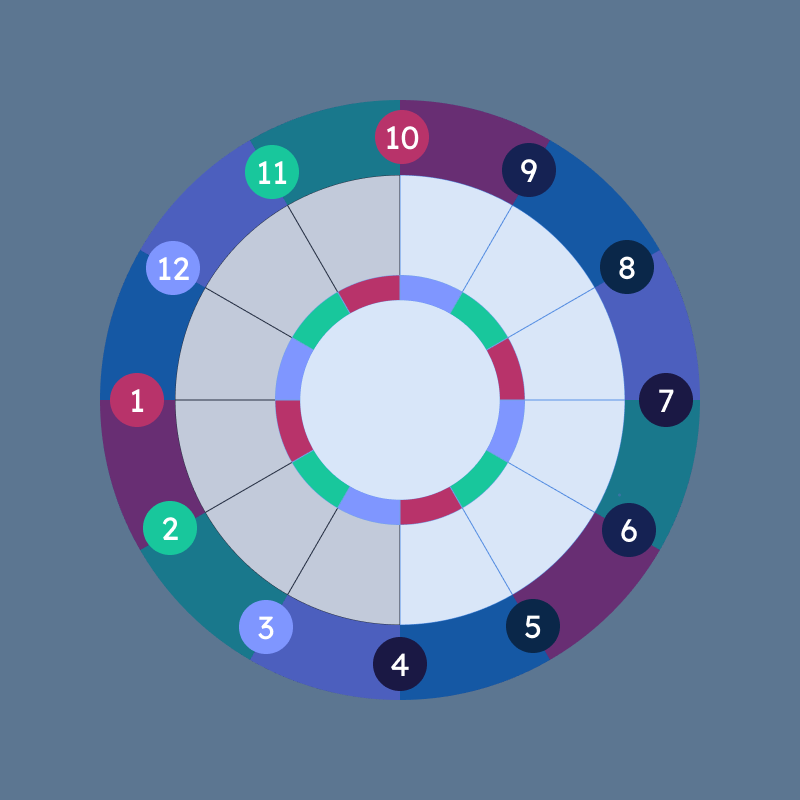
Third, the tables for many of the house systems list the houses in this order: eleventh, twelfth, Ascendant, second, and third, with the Midheaven listed at the top of the table in the same box in which the sidereal time is listed. This order confused me at first. But the logic is that the scheme starts with the Midheaven on top and proceeds in a counter-clockwise direction around the circle from there.
Thus, the houses listed are all the ones located on the left side of the chart, or the eastern hemisphere, starting with the Midheaven, or tenth house, at the top of the wheel and proceeding counter-clockwise from there.
Only Six House Cusps Listed
Fourth, notice that the table only lists six of the houses, not all of them. Because we are working with a circle, we are also working with polarities, with each house cusp having a partner directly opposite it on the wheel. Thus, once we know the cusp for one of the partners, or polarities, we know the cusp for the other: it is the same degree but the opposite sign.
Here are the natural polarities:
House 1 (ASC) - House 7 (DSC)
House 4 (IC) - House 10 (MC)
House 2 - House 8
House 3 - House 9
House 5 - House 11
House 6 - House 12
Latitudes Are Listed Down the Horizontal Axis
In the tables, latitudes progress in one-degree increments running down the horizontal axis from the top of each table to the bottom. Different sources have more or fewer latitude degrees listed. Astro.com’s tables go up to 66 degrees in their tables for both northern and southern hemispheres. The Koch Book of Tables I am using, created for northern latitudes, goes up to 60 degrees. I don’t know with certainty why only these latitudes are included. I assume one reason is because these latitudes cover the majority of inhabited areas. Another reason might have to do with the mathematical realities of some house systems - the house divisions start to break down at extreme latitudes. But these are educated guesses, not certainties.
Calculating the House Cusps
Calculating the house cusps involves a few different steps. Below, we’ll walk through each of them.5 We’ll start with the Midheaven because it takes fewer steps to work it out and because it will give us a piece of information we’ll need to calculate the Ascendant. Then, we’ll move on to the Ascendant. Once we know how to calculate the Ascendant, we’ll know how to calculate the rest of the house cusps because the steps are the same.
Calculating the Midheaven
Part 1: Finding the Time Tables
The first step in calculating the degree of the Midheaven is to find the time tables that flank the local sidereal time for the event. The local sidereal time we calculated for the Virgo New Moon was 17:22:05, so we’ll use that time to find our tables.
When we zero in, we find that the table immediately preceding our event time is for 17:20:00 and the one immediately after is for 17:24:00. We will use the data listed in each table. We’ll call the table for 17:20:00 Table 1 and the one for 17:24:00 Table 2.
Part 2: Finding the Difference: Midheaven Positions
Notice that, at the top of each table, the degree of the Midheaven is listed next to the sidereal time. Our work is to find where, exactly, between these two Midheaven degrees the Midheaven for our event is.
The first step in determining this event-specific position is to find the difference between the Midheavens listed in the tables. We do that by subtracting them. I share my result below. But first a couple of notes.
Notice that the Mideavens increased from Table 1 to Table 2. This observation will matter when the time comes to tweak our Midheaven to align it to the event time. Notice, also, that the Midheavens listed in both tables are in Sagittairus. Thus, we know from the start that our event Midheaven is in Sagittarius, somewhere between the two Midheavens listed in the tables.
One thing to note about my result below is that, in the tables of houses I am using,6 the Midheaven degrees are given only to the minute. In astro.com, they are given to the second. Thus, if you are using astro.com for your data, your result here and all along will be slightly different than mine. For those using astro.com’s Tables, I give the results I got using those tables after my results. They are in parentheses and italicized.
Here is my result:7
Difference between Midheavens (Michelsen): 00° 55′ 00″
(Using astro.com’s tables of houses for the Koch house system, my result is: 00° 55′ 17″.)
Later on, we will use this difference to adjust the degree of the Midheavean so that the one we use for our chart is for our event time rather than for one of the tables (or an estimate somewhere between them). Before we can do that, though, we need to calculate the time proportion between our event time and the time difference between the two tables. We do this because we don’t have a direct way to calculate the position change from the earlier time to our event time, which is what we ultimately need to nail down the Midheaven position for our event. Thus, we will use the time proportion as a round-about way to get the distance. Then, we’ll use the distance to finalize our result.
Part 3: Finding the Proportion: Time
To find the time proportion, we need to calculate three things: 1) the difference between the table times; 2) the difference between the event time and the Table 1 time; and 3) the quotient for these two differences.
Difference between Table Times
We’ll start with the difference in time between the tables we are using. We know that the tables are set up in four-minute time increments and we can see that for ourselves - 17:24:00 is four minutes ahead of 17:20:00. Thus, we know that the time difference is four minutes. To make use of this difference, we need to convert it into seconds. We do that by multiplying four minutes times sixty seconds. That gives us two hundred and forty seconds:
Time Difference between Tables: 4 minutes
Times:
Seconds per Minute: 60
Result: 240 seconds
Event-Specific Time Difference
Next, we need something with which we can compare this time difference. For that, we use the difference between the event time and the Table 1 time. To calculate that, we subtract the Table 1 time from the event time:
Event Time: 17:22:05
Table 1 Time: 17:20:00
Difference: 00:02:05
The difference is two minutes and five seconds. As with the difference in time between the two tables, to make use of this time difference, we need to convert it into seconds. We do that by multiplying two minutes times sixty seconds and then adding the remaining seconds to it:
Difference (Minutes): 2
Times
Seconds per Minute: 60
Preliminary Result: 120 seconds
Plus
Remaining Seconds: 5
Final Result: 125
The difference between the Table 1 time and our event time is 125 seconds.
Dividing the Time Differences
With these two differences calculated, we can find the proportion between them by dividing 1) the event-specific time difference by 2) the table-specific time difference:
Time Difference (Event-specific): 125 seconds
Divided by
Time Difference (Table-specific): 240 seconds
Proportion (Time): 0.5208
Our time proportion is 0.5208. We will use this proportion in the next part of the calculation process to help us determine the position change we need (from the earlier time to the event time) to tweak the Table 1 Midheaven to determine our event Midheaven. Later, we will also use it to zero in on the position of the Ascendant.
Part 4: Adjusting the Midheaven
Finding the Degree Change for the Event
We can now return to the degree difference we calculated earlier between the Midheaven positions in Table 1 and Table 2. It was fifty-five minutes (00° 55′ 00″). This difference is the degree change for the Midheaven that occurred over four minutes.
For our event, we want to know the change that occurred from the Table 1 time to our event time. In other words, we want to know the change in position that occured in the two minutes and five seconds that passed from the Table 1 time to our event time. We can determine that by multiplying 1) the table-specific degree difference (00° 55′ 00″) times 2) the time proportion we worked out in the last step (0.5208):
Table-specific Degree Difference: 00° 55′ 00″
Times
Proportion (Time): 0.5208
Result: 00° 28′ 38.64″ (rounded: 00° 28′ 39″)
Thus, in two minutes and five seconds, the Midheaven degree advanced zero degrees, twenty-eight minutes, and thirty-nine seconds.
(Using the results I worked out using astro.com’s data, I get: 00° 55′ 17″ x 0.5208 = 00° 28′ 47.49″ or 00° 28′ 48″.)
Finalizing the Midheaven Postion
To finalize the position of the Midheaven for our event time, we just need to add the degree distance we calculated in the last step to the Midheaven listed in Table 1. Using the results I calculated from the data found in Michelsen’s book, I get:
Midheaven Degree: 21° 17′ 39″
(Using astro.com’s data, I get: 21° 17′ 26″.)
We determined above that the Midheaven is in the sign of Sagittarius. Thus, the Midheaven for the Virgo New Moon set for Los Angeles is:
Midheaven (Michelsen): 21° 17′ 39″ Sagittarius
(Or, for astro.com, 21° 17′ 26″Sagittarius.)
Part 5: Evaluating the Result: Midheaven
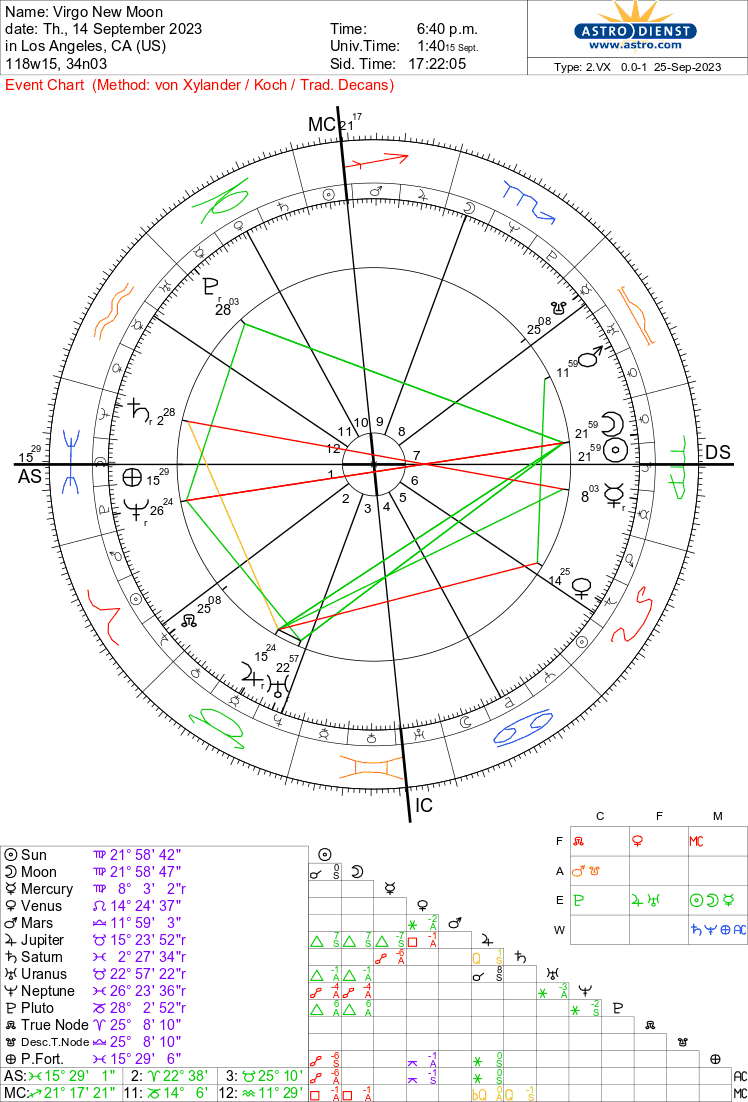
The results I got using Michelsen’s tables and also astro.com’s tables for the Koch house system are both accurate to the minute when compared with the Midheaven shown in the chart I created using astro.com’s online chart software program (included at the end of the article.) The Midheaven in that chart is 21° 17′ 21″ Sagittarius.
Comparing results, we can see that the one I got using astro.com’s tables is closer to the one generated using their software program,8 but the Michelsen result is not that far off. We know that part of the difference in results in this case comes down to different starting data. Another part probably comes down to rounding. And I suspect a third part comes down to more precise calculations used in astro.com’s chart software program (and probably others), though I can’t confirm that.
All things considered, from my perspective, the difference in seconds between my hand-calculated results and the computer results generated by astro.com’s software program is acceptable.
Next, we’ll calculate the Ascendant. While we can use the Midheaven to set the houses for Whole and Equal sign houses, and thus don’t need to know the Ascendant for that purpose, we still need to know the Ascendant to know the other chart angles. We may also prefer to set the houses using the Ascendant degree.
Calculating the Ascendant
Calculating the Ascendant is a little more involved than for the Midheaven because we need to factor in the latitude in addition to the time, whereas for the Midheaven, we only needed to factor in the time. But the steps for the latitude adjustments are essentially the same as for the time, just using the latitude data, instead. Once we’ve made these adjustments, we can return to the time and finalize the Ascendant position using the same steps we used to calculate the Midheaven.9
Part 1: Finding the Latitudes
In the tables, depending on your source, the latitudes are listed down the side or center of the page in one-degree increments. Scanning down the page, we want to find the two latitudes that flank the one for our event. Since our event latitude is 34° 03′ 7.92″, we are looking for the rows for 34 and 35 degrees.
When we find those, we note that the Ascendant positions listed, in both tables and for both latitudes, are in Pisces. Seeing this, we know that our Ascendant is in Pisces. We just need to figure out where, specifically, it is for our event.
Part 2: Finding the Degree Difference: Latitude
The first step in determining the Ascendant is to calculate the difference between the Ascendant positions listed for the lower and higher latitudes. We do this for each table. Here are the results I get using Michelsen’s tables:10
Table 1 Difference: 00° 15′ 00″ (-)
Table 2 Difference: 00° 13′ 00″ (-)
(Note: For those working with astro.com’s tables, your result for Table 1 will be one minute less than what I got, ie, 00° 14′ 00″ instead of 00° 15′ 00″. The Table 2 result is the same.)
Notice that the differences above are negative. The reason is because the Ascendant positions in both tables decreased from the lower to higher latitudes. In other words, in both tables, the Ascendant position listed for 35 degrees latitude is less than the Ascendant position listed for 34 degrees latitude. When we get to the final adjustment step, because of this decrease, we will subtract instead of add to get our final Ascendant position.
Part 3: Finding the Proportion: Latitude
Next, for each table, we need to find the proportion between 1) the difference between the two latitudes degrees that flank our event latitude and 2) the difference between the lower latitude and our event latitude. This proportion is called the latitude factor. Notice that we calculate it much like we calculated the time proportion, but using latitude data instead of time data. We also need to do it for both tables. (Correction: Since the same latitude applies to each table, we only need to calculate the latitude factor once.)
We’ll start with the first difference mentioned.
Difference between Table Latitudes
The tables list house cusp positions in latitude increments of one degree. Thus, we know that the difference between the two latitudes that flank our event latitude is one degree. We also see that 35 degrees is one degree more than 34 degrees, confirming that the difference is one degree. To use this difference, we’ll need to convert it to minutes. Since there are 60 minutes in a degree and only one degree, the conversion works out to be 60 minutes (1 x 60 = 60).
Distance between the Event Latitude and Lower Latitude
The second number to calculate is the difference between the event latitude (34° 03′ 7.92″) and the lower latitude (34 degrees):
Event Latitude: 34° 03′ 7.92″
Lower Latitude: 34° 00′ 00″
Result: 00° 03′ 7.92″ (rounded: 00° 03′ 08″)
This difference tells us how far into the degree our event took place, latitude-wise.
Calculating the Proportion
To find the proportion between the event-specific difference in latitudes (difference between the event latitude and the lower latitude) and the latitude-specific difference (difference between the lower and higher latitudes), we divide the former by the latter:
Latitude Difference (Event-specific): 00° 03′ 08″
Divided by
Latitude Difference (Table-specific): 60′
Result: 0.0522
Thus, 0.0522 is our proportion, or latitude factor. We will use it to find the amount we need to adjust the Ascendant position by, latitude-wise, for each table.
Part 4: Adjusting the Ascendant: Latitude
Now, we can return to the difference we calculated between the Ascendant positions for the two flanking latitudes for each table. For Table 1, the Ascendant decreased by 15 minutes (00° 15′ 00″). For Table 2, the position decreased by 13 minutes ( 00° 13′ 00″).
(For the astro.com calculations, the Table 1 Ascendant decreased by 00° 14′ 00″.)
Determining How Much to Adjust the Ascendant by
To be able to tweak the Ascendant positions latitude-wise, we multiply the above changes in the Ascendant position times the proportion, or latitude factor:
Table 1
Table 1 Difference (between Ascendant Positions for Each Latitude): 00° 15′ 00″
Times
Latitude Factor (or Proportion): 0.0522
Result: 00° 00′ 46.98″ (rounded: 00° 00′ 47″)
(For the astro.com difference, the calculation is 00° 14′ 00″ x 0.0522. That equals 00° 00′ 43.84″, which rounds to 00° 00′ 44″.)
Table 2
Table 2 Difference (between Ascendant Positions for Each Latitude): 00° 13′ 00″
Times
Latitude Factor (or Proportion): 0.0522
Result: 00° 00′ 40.71″ (rounded: 00° 00′ 41″)
These results tell us how much to adjust the Ascendant positions by for each table, latitude-wise.
Making the Latitude Adjustment
Now, we make the adjustment. Because the degrees decreased from the lower latitude (34 degrees) to the higher latitude (35 degrees), we will subtract the distances from the lower latitude Ascendant positions. Here are my results:
Table 1 Ascendant Degree (Latitude-Adjusted): 14° 42′ 13″
Table 2 Ascendant Degree (Latitude-Adjusted): 16° 12′ 19″
(Using the astro.com table and calculated data, the result I get for Table 1 is: 14° 41′ 16″. The result for Table 2 is the same as the Michelsen-based result.)
With these latitude-adjusted Ascendant positions calculated, we are at the same place we started at when we calculated the Midheaven, ie, we have one position for each time table. Thus, we can now follow the steps we took to adjust the Midheaven position, time-wise.
Part 5: Finding the Position Change for the Event Time
To finalize the Ascendant position, we need to find the Ascendant position change from the earlier time to the event time. Just as was so for the Midheaven, to determine that change, we first have to find the difference between the Ascendant positions for each table. Then, we can use the time proportion we calculated for the Midheaven to determine the position change to the event time.
Finding the Degree Difference between Ascendants
To find the difference between the two Ascendants, we use the two latitude-adjusted positions we calculated above:
Latitude-Adjusted Ascendant (Table 2): 16° 12′ 19″
Minus
Latitude-Adjusted Ascendant (Table 1): 14° 42′ 13″
Result: 01° 30′ 06″
(Using the astro.com Ascendant position result for Table 1, we get: 16° 12′ 19″ - 14° 41′ 16″ = 01° 31′ 03″.)
Finding the Degree Change (Event)
Knowing the above distance, we can find the position change from the lower time to the event time by multiplying the difference between the two Ascendant positions (01° 30′ 06″) times the time proportion that we worked out for our Midheaven calculations. The time proportion was 0.5208:
Difference between Ascendants: 01° 30′ 05″
Times
Time Proportion: 0.5208
Result: 00° 46′ 55.44′ (rounded: 00° 46′ 56″)
(Using the difference in Ascendant positions calculated from astro.com’s data, I get: 01° 31′ 03 x 0.5208 = ″00° 47′ 25.13″ or 00° 47′ 25″.)
This result tells us how much the Ascendant position changed from 17:20:00 to the event time.
Part 6: Finalizing the Ascendant Position
Now we just need to tweak the Ascendant position by adding the degree change we calculated in the last step to our latitude-adjusted Ascendant for Table 1. Because the latitude-adjusted Ascendant degree increased from Table 1 to Table 2, we add the degree change:
Table 1 Ascendant: 14° 42′ 13″
Plus
Proportion: 00° 46′ 56″
Result: 15° 29′ 09″
(Using the results I got using astro.com’s data, I get: 14° 41′ 16″ + 00° 47′ 25″ = 15° 28′ 41″.)
We already determined that the Ascendant is in Pisces, so our final result is:
Ascendant: 15° 29′ 09″ Pisces
(Or, for astro.com’s Tables, 15° 28′ 41″ Pisces.)
Part 7: Evaluating the Result: Ascendant
Astro.com’s Ascendant for the Virgo New Moon chart generated using their software program and using the Koch house system, is 15° 29′ 01″. (See the astro.com chart at the end of the article.) Thus, our result is only eight seconds off. Oddly, the result I got using astro.com’s tables is off by 20 seconds, but that is still within reason. At this time, I do not understand why the astro.com result would be further off from astro.com’s astrology program results than the result I calculated from Michelsen’s tables.
My best guess, generally speaking, as to the reason for the discrepancies between hand-calculated results and software program results continues to be that the astrology programs use more refined formulas to calculate their results. Rounding may also factor in. And, of course, human error can also play a part.
Drawing Up the Chart
With the Midheaven and Ascendant worked out, we can draw up the chart using either Whole Sign or Equal houses. If we want to draw up the chart using another house system, we will need to calculate the rest of the house cusps using a table of houses for the system we want to use. While I calculated the rest of the cusps and show my results below, after I show the Whole Sign and Equal house charts, I did not draw up a chart for the Koch house system.11 Instead, I show the chart I created on astro.com using the Koch house system.
Drawing Up the Whole Sign Chart
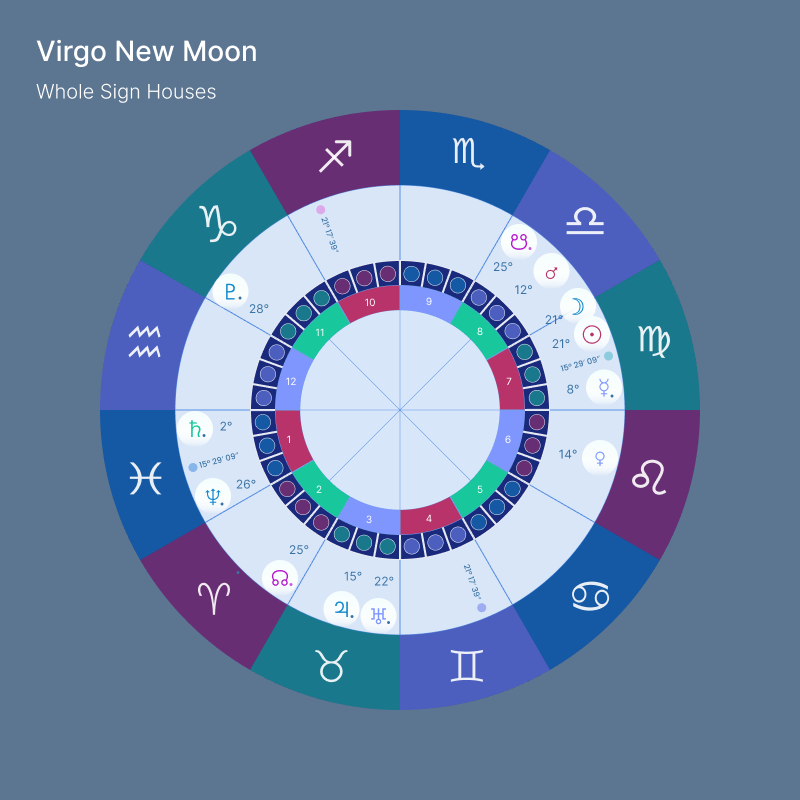
Every house cusp in the Whole Sign house system begins at zero degrees of a sign. Which sign aligns with which house is determined by the angles. Looking at the Ascendant, we determined that, for the Virgo New Moon in Los Angeles, it is 15° 32′ 45″ Pisces. Thus, the first house begins at zero degrees Pisces and each house follows from there - the second house begins at zero degrees Aries, the third house begins at zero degrees Taurus, the fourth house begins at zero degrees Gemini, and so on.
Here is the Whole Sign house chart I drew up. Notice that Saturn is in the first house. Notably, it will be in a different house in the Equal sign charts. When you look at the other charts below, see if you notice other differences in terms of planet locations.
Drawing Up the Equal Sign Chart: Ascendant
Like in the Whole Sign house system, in the Equal house system, every house cusp is the same degree, creating twelve equal-sized houses of thirty degrees each. But the degree that is used for the cusps of the houses is different. To set those, the Midheaven or Ascendant degree is used. Since these degrees are not likely to be zero degrees of a sign, all houses will start somewhere in the signs, rather than at the start of them like in Whole Sign houses.
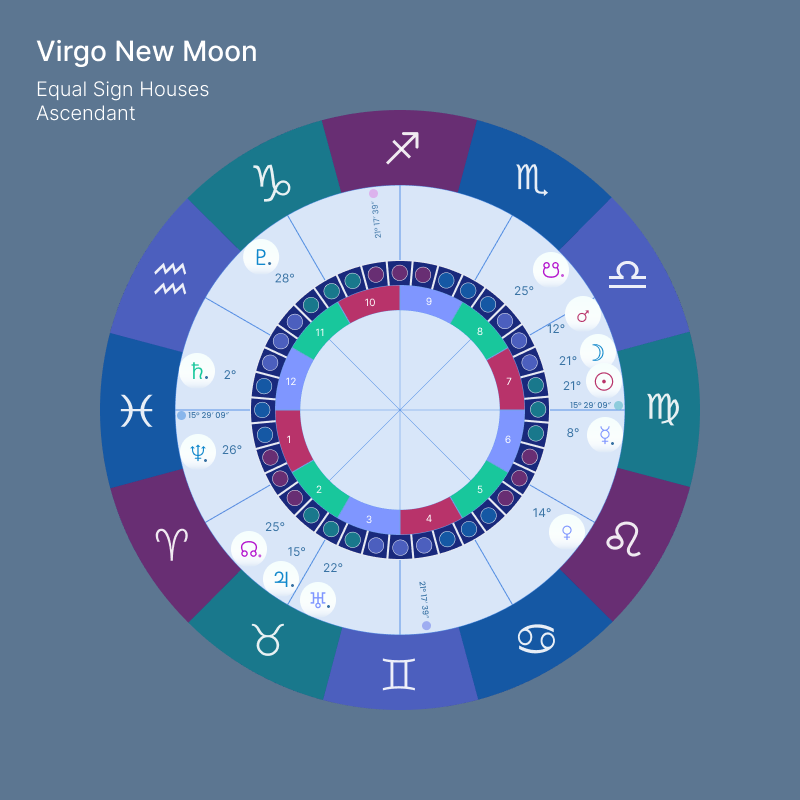
In the first chart below, I show the Equal house chart set for the Ascendant. Below that, I show it for the Midheaven. For the Ascendant version, notice that the Ascendant degree hugs the horizontal line on the left side of the chart. This is my way of showing that the start of the first house is the Ascendant degree, which is 15° 29′ 09″ Pisces. The same is true for its polarity, the Descendant, which hugs the horizontal line on the right side of the chart, initiating the 7th house cusp at 15° 29′ 09″ Virgo, directly opposite the Ascendant.
For the Midheaven (pink dot at top of chart with associated degree), notice that it floats in the tenth house. This is so because its degree, 21° 17′ 39″, is greater than the Ascendant degree, and thus greater than the tenth house cusp degree. If its degree had been less than the Ascendant’s, it would have fallen in the ninth house. The same is true for its polarity, the IC. It floats in the fourth house because its degree is greater than the degree of the Ascendant, and thus greater than the degree of the fourth house cusp.
Notice that, in this chart, unlike in the Whole Sign house chart above, Saturn falls in the twelfth house. In the Whole Sign chart, it falls in the first house. If you look closely, you will see that other planets have also shifted houses.
One final note. Because of space constraints, the Moon looks like it falls in Libra, but it is actually in Virgo. The tell is that its degree is the same as that of the Sun, indicating that this is a chart for a New Moon, specifically the Virgo New Moon as both planets occupy the same degree in Virgo.
Drawing Up the Equal Sign Chart: Midheaven
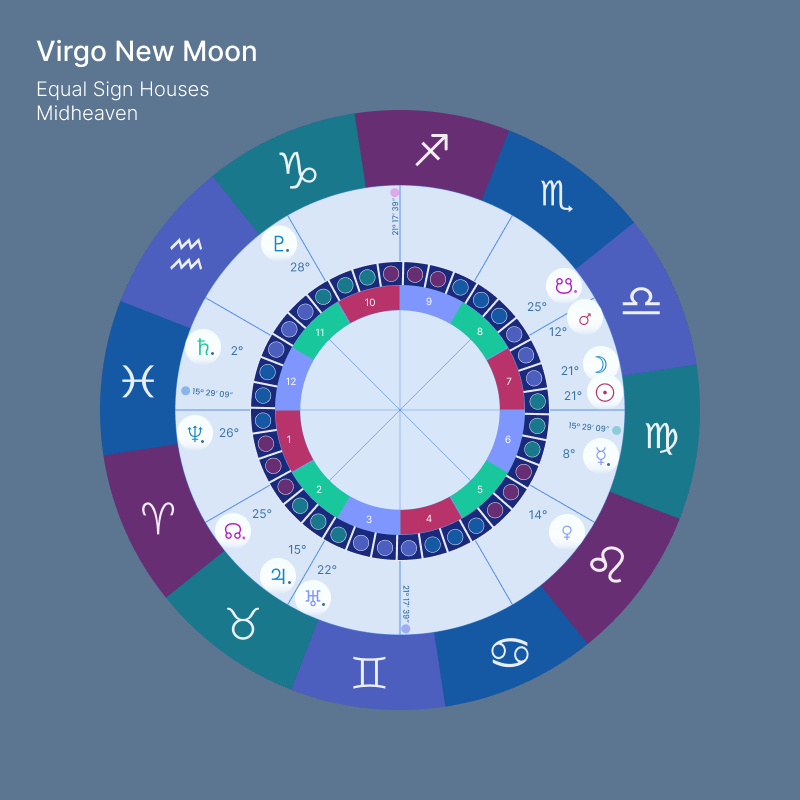
For the Midheaven version of the equal sign chart shown below, notice that, this time, the Midheaven and IC are anchored to the tenth and fourth house Cusps, respectively, thus indicating that these angles mark the start of these houses. Since the degree of the Midheaven is 21° 17′ 39″ Sagittarius, each house begins at this degree, but in a different sign, with each house beginning thirty degrees after the preceding one.
Because the Ascendant is not the same degree as the Midheaven, it ends up floating in the houses, as does its polarity, the Descendant. Located at 15° 29′ 09″ of their signs, they fall before the start of the first and seventh houses, respectively, falling, instead, in the twelfth and sixth houses. Because of this subtle difference, the chart reads slightly differently than it would if these angles fell in the first and seventh houses.
As with the Equal Sign chart drawn up using the Ascendant degree to set all the other house cusps, Saturn is in the twelfth house in this chart, not the first as it is in the Whole Sign house chart. Notice that other planets have also shifted house positions.
The Rest of the House Cusps
The calculations for the rest of the house cusps are the same as for the Ascendant. Below, I list the results I got using the tables found in The Koch Book of Tables:*12 They are all accurate to the minute when compared with a chart generated in astro.com using the Koch house system. (See chart below.)
11th House Cusp: 14° 05′ 38″ Capricorn
12th House Cusp: 11° 28′ 35″ Aquarius
2nd House Cusp: 22° 37′ 50″ Aries
3rd House Cusp: 25° 10′ 15″ Taurus
*Barring any unexpected circumstances, I will have the Notion worksheets with the calculation steps and results for each house cusp up by the end of the week, hopefully in the next day or two (today is September 26th). Where copyright isn’t an issue, the tables will also show the calculation steps.
(Using astro.com’s tables, the results I got are: 11th House Cusp: 14° 05′ 09″ Capricorn; 12th House Cusp: 11° 28′ 32″ Aquarius; 2nd House Cusp: 22° 37′ 20″ Aries; 3rd House Cusp: 25° 09′ 17″ Taurus.)
From the house cusps we calculated above, we can determine the cusps for the rest of the houses by finding the polarity for each cusp:
5th House Cusp (11th House polarity): 14° 05′ 38″ Cancer
6th House Cusp (12th House polarity): 11° 28′ 35″ Leo
8th House Cusp (2nd House polarity): 22° 37′ 50″ Libra
9th House Cusp (3rd House polarity): 25° 10′ 15″ Scorpio
The polarities for the angles are:
Descendant (ASC polarity): 15° 29′ 09″ Virgo
Imum Coelum/IC (Midheaven polarity): 21° 17′ 39″ Gemini
Here is a chart generated in astro.com for the Virgo New Moon using the Koch House system.13 The house cusp positions are listed at the bottom.
Review and Conclusion
In this article, we calculated the house cusps using tables for the Koch house system. Along the way, we were also able to determine the house cusps for the Equal and Whole Sign house systems. The latter two depend only on either the Ascendant or the Midheaven for determining the rest of the house cusps. In the case of the Whole Sign houses, neither the Midheaven nor the Ascendant line up with a house cusp. Instead, each floats in a house.
With the Equal House system, either the Midheaven is used for the cusp of the tenth house, setting the rest of the house cusps to that degree, or the Ascendant is used for the cusp of the first house, setting the rest of the house cusps to that degree. If the Midheaven is used, then the Ascendant floats in a house. If the Ascendant is used, then the Midheaven floats in a house.
When it comes to other house systems, like the Koch house system we used for our example, the Ascendant and Midheaven are both used as house cusps. The Ascendant serves as the first house cusp and the Midheaven serves as the tenth house cusp. These points, together with their opposites, divide the chart into four quadrants, with each quadrant then divided into three houses. One of the things that distinguishes these kinds of house systems from one another is the way in which the quadrants are divided. How it is done in each system is based on complex astronomical considerations. The result is that, unlike with Whole Sign and Equal Houses, the houses are not all the same size.
We now have all the pieces we need to calculate a chart for an event in the Northern Hemisphere. In the next article (and possibly more), we’ll look at the Virgo New Moon chart set for somewhere in the Southern Hemisphere and east of the Prime Meridian. That will give us everything we need to be able to calculate a chart for an event that takes place anywhere in the world.
If there is a specific location south of the equator and east of the Prime Meridian that you would like to see the chart set for, let me know in the comments!
May everyone be happy, healthy, and well
Updates
September 27, 2023:
Yesterday, just after posting, I noticed a couple of spelling errors so I corrected those. I also edited a couple of sentences to make them more clear.
Today, I changed the title. I use a working title when I edit and sometimes forget to change it before publishing. I think what I changed it to is better.
Previous Chart Calculation Series Articles


References
Astrodienst. (n.d.). Terms of Service. Astro.com. Retrieved September 23, 2023. https://www.astro.com/contact/user_e.htm
Campbell, Dave. (2019a, Jan 13). How to calculate birth chart part 3 of 5. The American Federation of Astrologers [Video]. Youtube.
Campbell, Dave. (2019b, Jan 13). How to Calculate birth chart part 4 of 5 , Natal Calculation, American Federation of Astrologers [Video]. Youtube.
Cuemath. (n.d.) Proportion. Cuemath.comhgx. https://www.cuemath.com/commercial-math/proportion/
Michelsen, Neil F. (1985). The Koch Book of Tables. ACS Publications: San Diego, CA.
Ward, Ken. (n.d.a). Astrology: Calculating the MC. Trans4mind.com. https://trans4mind.com/personal_development/astrology/Calculations/calcMC.htm.
Ward, Ken. (n.d.b). Astrology: Calculating the Ascendant. Trans4mind.com. https://trans4mind.com/personal_development/astrology/Calculations/calcAsc.htm
Notes
House cusps will vary from one house system to another, though the Ascendant and Midheaven will be the same. Because the signs always follow in the same order, the sign after Leo will always be Virgo, and the sign after that will always be Libra. But, in some house systems, two house cusps in a row might fall in the same sign. Or, in the case of a very large house, a house cusp might fall in, say, late Virgo, with the house encompassing all of Libra. In this situation, the next cusp would fall not in Libra but in Scorpio, thus skipping a sign. The sign that is enveloped is called an intercepted sign.
One of the reasons I have a goal to build an astrology software program is so that the phase wheel can be more easily used with more house systems.
The calculation steps I am using are based on the approach Ken Ward teaches for calculating the Ascendant in his chart calculation article series. (See both of Ward’s articles listed in the References, one on calculating the Midheaven and one on calculating the Ascendant.) In his approach, he works out the latitude calculations first, then goes on to work out the time calculations. Another possible strategy is to work through the time calculations first, then work through the latitude calculations. This second approach is taught by Dave Campbell in his video series. (See both of the entries for Campbell in the References.)
I found a used book with the tables of houses for the Koch house system, so used the data in that for my calculations. (See Michelsen.) Also, I realized after being almost done with the article that using the data in a book might not have been the best approach for showing others who are probably more likely to be using astro.com’s tables. I apologize for that. My primary reason for that choice was because of the personal use clause in astro.com’s terms. But, as I was finishing the article, I realized it would have been better to use astro.com’s tables and probably would have been ok. What I decided to do was add in the calculations and results I got using astro.com’s data after the results I got using the Michelsen tables rather than changing everything I had already done. Hopefully, that will work.
See footnote 3.
See footnote 4.
Due to copyright, I am not sharing the data from the tables of houses I am using.
For the chart generated using astro.com’s software program, I used the Koch house system and typed in the following date, time, and location: September 14, 2023, 18:40, Los Angeles, CA.
See footnote 3.
See footnote 7.
The main reason I didn’t draw up the chart for the Koch houses is because of design limitations in the chart template I created for both phase and sign charts. They work great for Equal and Whole sign houses but not for charts for other house systems. This limitation is one of the reasons I have a goal to create an astrology software program. As explained in footnote 2, I would like to create something that makes it possible to use the phase wheel (and sign wheel) I use with any house system.
See footnote 4.
As written in astro.com’s terms of service, displaying charts created by a user using their site is allowed. See Astrodienst in the References. Here is the specific statement in their terms: “A user is allowed to publish chart drawings or tabular data which she/he has created on astro.com from data she/he entered herself/himself. Astrodienst grants permission for that, without the need to ask.”